Aaron B. Cohen
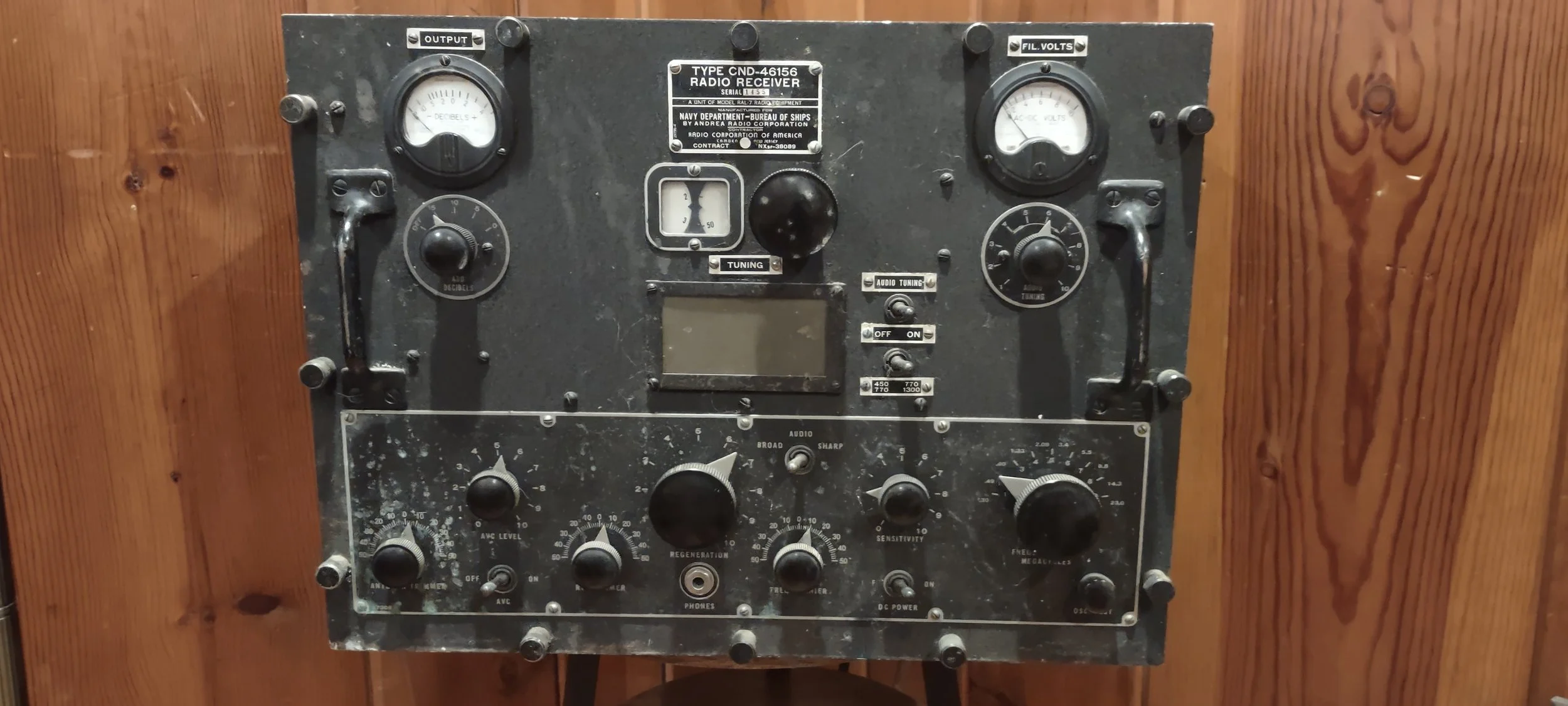
Last night I kissed my old love, and embraced it as tenderly as I could, given that it’s a big metal box with nary a rounded edge or soft surface.
Nothing I heard through the speaker prompted this burst of affection for my old shortwave radio, which has been silent for 46 years. My joy was about reunification. For the first time in nearly five decades, the radio and I are sharing a room, just like we did when I was young.
In the Seventies, long before the Internet, shortwave radio was the only way to get my fix of Middle Eastern music. I needed a receiver powerful enough to fish the ionosphere for faint signals from thousands of miles away.
I found the perfect set waiting for me in an antique store in Evanston, IL.
“I have a World War II military receiver that’s new in the box,” the proprietor said. My pulse quickened as he led me past polished dining room tables, floor lamps with fussy shades, stuffed wing chairs, and shelves overflowing with China.
The radio had hibernated for 30 years. It was massive and weighed some 70 pounds--hefty enough for naval warfare. WWII naval vessels used such radios to find the enemy on the high seas. I was eager to deploy it in my own battle to pull in Türkiye’nin Sesi (Voice of Turkey) from the ionosphere.
I paid my $75 and schlepped the hulking set back to my rented room in Bloomington, Indiana, where I was a junior in college. I strung an antenna, hooked up the radio and started to figure out the controls. Everything was analog: the knobs and switches were connected to cables and tuning coils; the controls were smooth as silk and decisively, satisfyingly tactile as only a precision instrument can be.
Built long before transistors, the set used vacuum tubes, which took time to warm up. When they did, electrons coursed through the radio’s copper veins and it came alive, delivering the world to my fingertips.
I would sit by the radio at night, twiddling its knobs and switches, while a cacophony, like the soundtrack of a sci-fi thriller, infiltrated the room. Poor atmospheric conditions often made finding Türkiye’nin Sesi challenging; when it came in clearly, I was ecstatic.
When I left Bloomington in 1979, the radio stayed behind, in a friend’s basement. Several years ago, I asked him if he still had it.
“Yes! And it wants to be reunited with you,” he said.
Last year, my wife and I bought a house in Bloomington. Recently I wrestled the old radio into the car and brought it to my den. I gaze at my old friend and remember the long hours we spent together, sweeping the meter bands and combing the kilocycles, searching for my music, and pondering a future that turned out as I dreamed.