Elliot Zashin
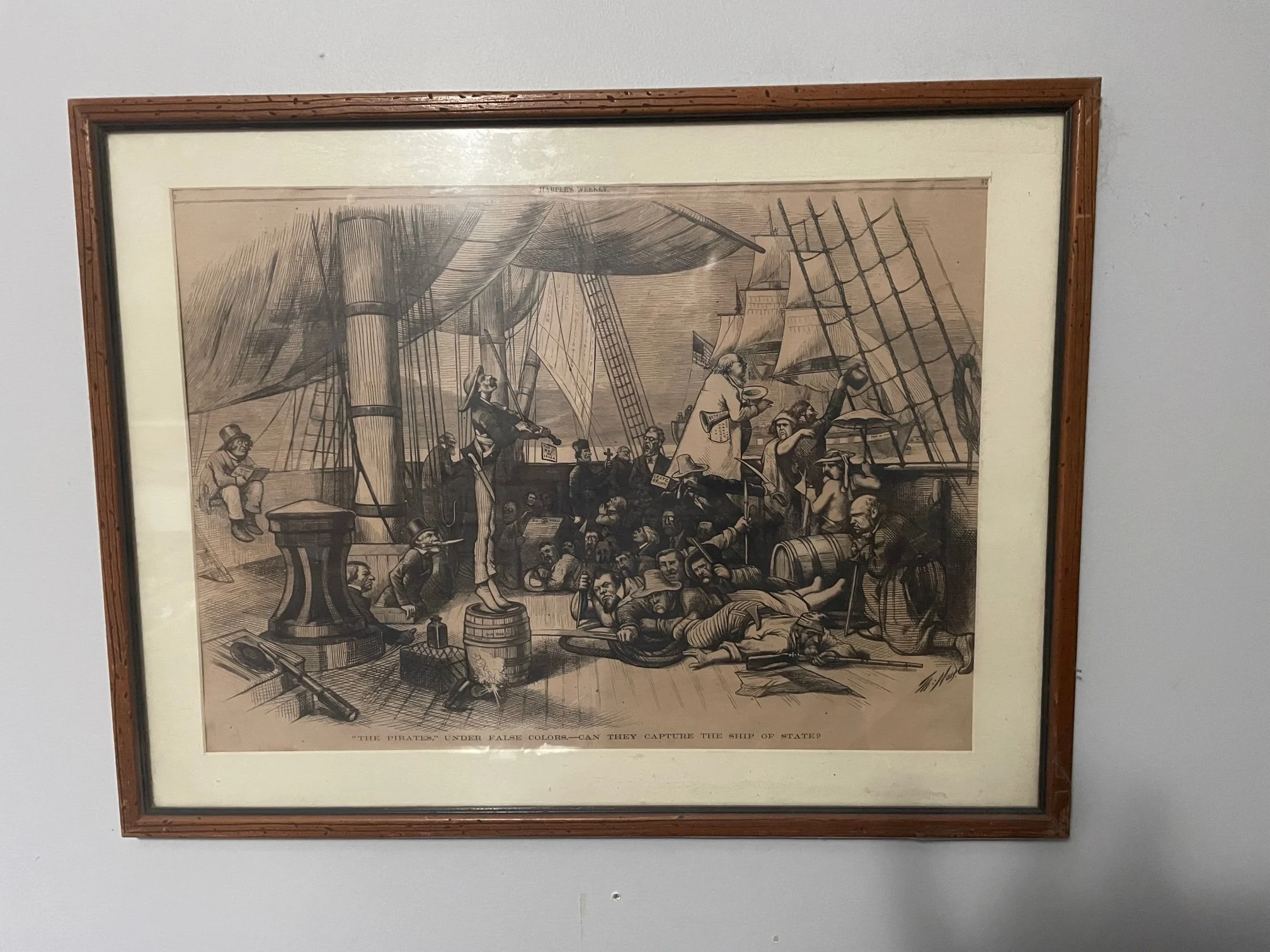
I don't know what drew me to them, but as a young teenager I became fascinated by political cartoons. Where I came across the Harper's Weekly in which I saw my first Thomas Nast cartoon is anyone's guess, but I immediately had the impulse to collect his work. It seems strange today that I used to take such a long trip on the commuter train from my suburban town into Manhattan and then hop on a subway train to the Lower East Side where there were many used bookstores. In hindsight, I'm also a little surprised that my parents let me go by myself, but the Manhattan of the early to mid-1950s was, perhaps, largely safe—it was a different time.
Harper's Weekly was a major national publication, and Nast was its main illustrator; this was before photographic reproductions were available, and all the illustrations were sketches. Nast sketched scenes from the Civil War, as well as offering political commentary through his cartoons. Among the best known were his cartoons of Boss Tweed, apparently the most powerful figure in the Tammany organization that controlled New York City in the 1870s. Nast had an incredible knack for caricature, and his portrayals of Tweed (with his huge paunch) and his associates as scoundrels robbing the public till were quite recognizable even to the politically unsophisticated. I don't know how much influence Nast's cartoons actually had in the successful campaign to drive Tammany from its monopoly of NYC's finances, but they probably served to memorialize Boss Tweed.
Another find at the bookstores was a volume of cartoons by Louis Raemaekers drawn for the Amsterdam Telegraaf and widely reproduced in Europe during WWI; these were very different from Nast's work, but they were a powerful commentary on major political figures and the horrors of that war. As I grew older, I began to add more contemporary political cartoonists to my collection and develop a serious interest in politics. I eventually found David Low, whose rather witty cartoons about post-war international politics appeared in major British newspapers. In addition, one of my aunts had a subscription to the NY Post, which in those days was a liberal Democratic newspaper popular in NYC; it regularly published Herblock's cartoons of “Tricky Dick” Nixon on the editorial page, and she would cut them out and save them for me.
But what was I to do with these books and journal pages/cut-outs when I went off to college to study political science and my parents moved from New York to Arizona in the late 1950s? Mostly they got stored away at my parents' home in a large steamer trunk I inherited from that same aunt. A few of my Nast pages were kept by close friends, whose children saved them for years, unbeknownst to me, and eventually returned them to me, intact.
I went on to graduate school to study political science and later embarked upon my first career as a political science professor. In the mid-1970s, my wife and I bought a home in Wilmette, IL, and she decided that my lasting penchant for saving memorabilia could become a sort of home decor, spending hours at The Great Frame Up in Evanston to mount a few of my favorite Nast cartoons in attractive frames. And though I now live elsewhere with a different partner, I still have almost all of this collection in my study; one of Nast's very formidable cartoons adorns the wall above my PC. As was his forte, he portrays Horace Greeley, a well-known editor and presidential candidate, as the innocent-appearing front man for a pack of scoundrels. I've long since stopped collecting and retired from a second career that had nothing to do with political science, and it's safe to say that political cartooning is in decline these days. However, I still appreciate a clever cartoon that can capture the essence of a public figure or the meaning of a political event and sometimes even spark a newfound interest in politics.