Kay Harel
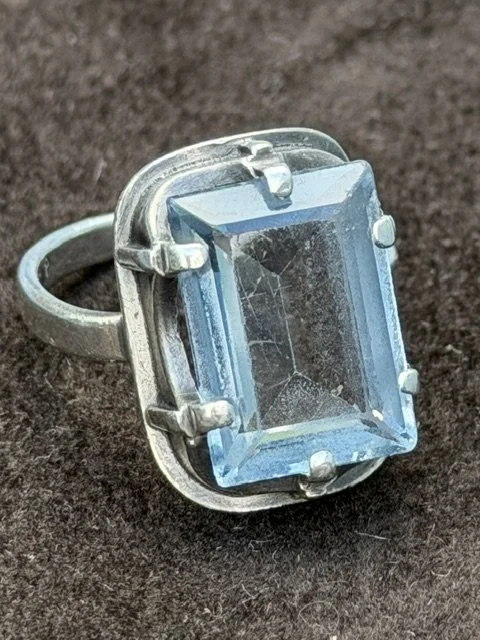
Exactly how light colors the sky all the blues of the palette is how my mother’s old ring makes those selfsame colors. Diamonds and sapphires can only dream of blue chalcedony’s unique luminescings, created by its molecular structure, a complex quartz. The stone responds to shifts in ambient light, differentially diffusing photons into new blues. The stone acts like the sun.
Quite a few shades of blue. Sunlight ignites the top to flash a white-hot blue, like the haloes inside flames. Grey skies sap the hue, which pales to match laden storm clouds, a shimmering lavender-grey. High noon brings a merry periwinkle. Dusk conjures an indigo one might drown in. The dim of a curtained room fades the blue near to glass. But always, silvery highlights spike across the perimeter facets like shooting stars.
What creates this kaleidoscopic chameleon? Mostly: Its constituent crystals are teeny-tiny, microscopic in some grand order of magnitude-in-reverse. Blue chalcedony’s crystals bear the term cryptocrystalline because they were hidden to nineteenth-century microscopes. They are mere blurs to today’s fanciest gear, and must be sliced in infinitesimally small slivers to be seen only in scant outline. Cryptic is in the eye of the beholder. But blue chalcedony does contain multitudes.
Another physical-magical aspect at play is the ring’s dimensions: their ratio is off by only a hair’s breadth or two from the Golden Rectangle, aka the “divine proportion” (ratio 1 to 1.6). Thinkers in art and science have held for centuries that this simple shape is, universally, perfect beauty, the essence of harmony. Why? Try reading the gobbledygook about infinite symmetry or the Fibonacci sequence, or ask a mathematician or evolutionary biologist.
In any case, the ratio pervades nature. It defines, for example, the dolphin’s aerodynamic body and the astronomical strength of the ant. We may spot the ratio throughout culture: in the grace of ancient Greek buildings, the masterpieces of Leonardo da Vinci, and the dimensions of our era’s credit card.
The lapidary who cut this two-carat semi-precious jewel likely chose the divine proportion to enhance the innate serenity. Blue chalcedony is not rare but it is often cloudy, so a serendipitous chunk, translucent and fat, would inspire a crafter to cut and facet quite something.
The stone’s further journey? In the late 1940s my mother sailed from New York City to Tel Aviv, a bride crossing the pond to meet her in-laws. She had never once been away from her Brooklyn home. She could never remember what port the ocean liner visited—in Morocco, Turkey, Greece? Wherever, her husband bought the ring and a matching bracelet, a honeymoon gift presaging a ‘til-death-do-us-part marriage. Jewelry of this age is called vintage, which describes their union.
But my mother was not one for baubles, not luxe, not cheap. The set sat in her jewelry box for longer than two decades, tarnishing, entrancing. She gave me the ring when I was 14 years old. The light in the stone is alive.