This story starts like so many from that time of my life. “A few of us are sitting around, real stoned, trading stories….” Someone describes a recent visit to a wax museum where they saw a guillotine, with a headless body on one side of the blade and a head in a basket on the other. I find myself describing a vision of that guillotine scene, rendered not in wax but in yarn. I have no clue where that idea came from.
I announce on the spot that I plan to open a museum called Crocheted Atrocities, filled with exhibits like at the wax museum, but all crocheted. Eventually I will retire on profits generated by gate fees and the gift shop. The first display will be a beheading, then on to people like John Wilkes Boothe, Freddy Krueger, President Lincoln, and maybe Jane Mansfield after her fatal crash. I promise that every donation will be acknowledged on a plaque next to its exhibit.
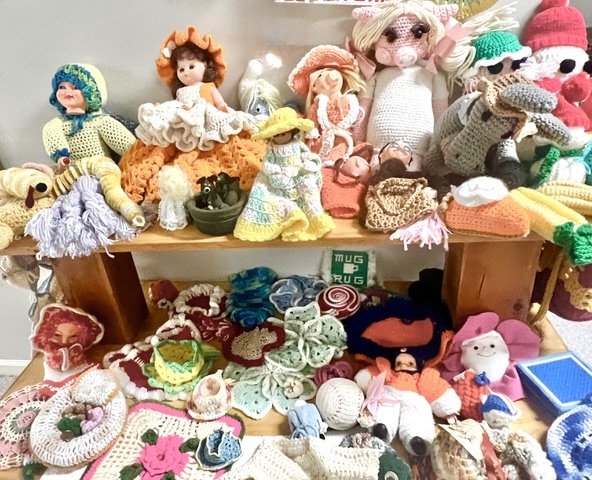
And so began my crochet collection. It started out with some little items, like hot pads for the kitchen and a cover for a spare toilet paper roll—not just a plain vanilla cover, but an octopus, a pink and white cylinder with googly eyes and dangling crocheted tentacles.
Friends gave me items they’d picked up at craft fairs all over the country, plus a few of their own precious family heirlooms. As time went on, the pieces got more elaborate, including: a large family of various size snowmen with matching winter hats and scarves; a flying saucer whose cockpit closes with a button to protect its half dozen alien finger puppet crew; a duck that shits M&Ms; two large versions of Miss Piggy and a cornucopia spilling fruits and vegetables. There have been lots of great little gifts too like: a crocheted baseball, a donkey, a couple of dogs, a slew of Christmas ornaments, a slice of pumpkin pie alamode, several beer cozies and two cups and saucers. (Unfortunately, no guillotine.)
Most of my adult life I lived and worked in rural towns, which provided plenty of opportunities to browse church craft fairs, farmers’ markets and flea markets well stocked with crocheted items. I’d sort through the pieces a craftswoman had displayed on a cafeteria table, with an eye out for the most unique and/or the ugliest ones. These women—they were all women because crocheting is forbidden to men—were always flattered and proud to have a male of the species show interest in their art, appreciate it out loud and even buy something.
My collection used to live in a big hamper in a closet. A few years ago I finally liberated it and displayed on shelves in our finished basement. I doubt I’ll ever open that museum, though. I will just have to find another way to make a little extra cash for retirement.