Joseph M. Madda
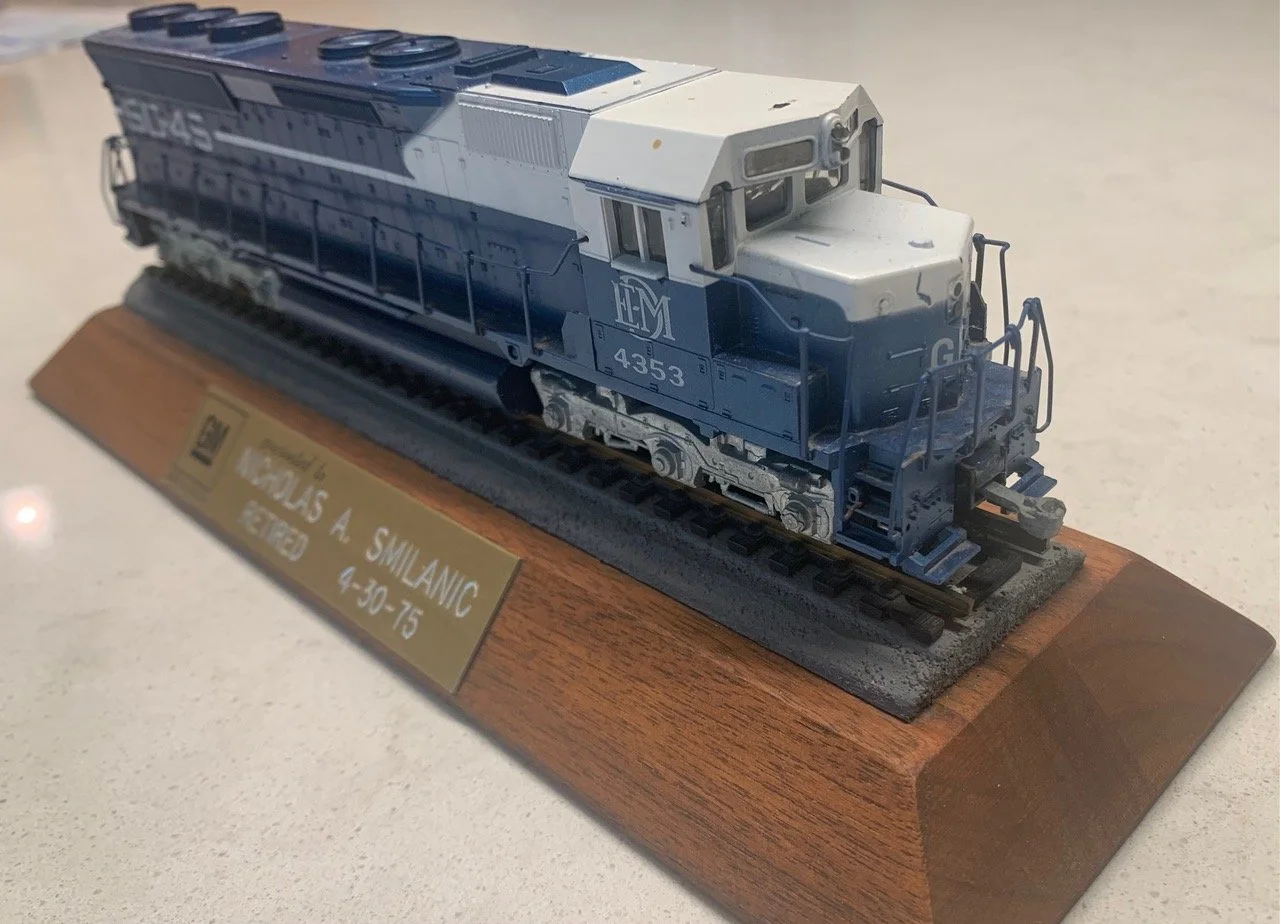
My late father-in-law, Nicholas Smilanic, received this memento of a diesel electric locomotive when he retired from General Motors Corporation’s Electro Motive Division in 1975. It sat in his home for many years, and now I have it in mine. Nick, an electrical engineer, worked at the main EMD plant in La Grange, Illinois, for over three decades. This gargantuan site, one of the largest industrial facilities in the US, dominated the diesel electric locomotives market for decades.
The little model shows the primary product, the workhorse diesel electric locomotive used for freight hauling everywhere. Commodities and consumer goods, military materials in wartime and products for the good life in peace time. Yes, we owe the widespread and easy availability of so many things that sustain us, things we often take for granted, to trains and the powerful engines that move them.
In 1930, General Motors Corporation purchased a small start-up firm, The Electro-Motive Engineering Corporation of Cleveland, Ohio. That company, founded in 1922 by Harold Hamilton and Paul Turner, had pioneered the manufacture for railroads of new internal combustion diesel/electric propulsion (with technology originally developed by General Electric Corporation). How does it work? The ignition of diesel fuel pushes pistons connected to an electric generator. In turn the resulting electricity powers motors connected to the locomotive’s track wheels. This electric technology would quickly make the steam locomotive, up to then dominant over railroading for a century, obsolete. GM anticipated that trend and, therefore, was eager to enter the market. A few years later it renamed its new business entity the Electro Motive Division.
In 1935, GM opened a new EMD central plant and headquarters in La Grange, Illinois. The massive plant dependably would crank out locomotives through 1993. After World War II for some time it would enjoy over 70% of American locomotive sales.
I remember Nick saying his plant produced one new locomotive an hour in its heyday. EMD did establish other plants in the US and overseas, but none were as big as the Illinois headquarters site. GM locomotives would be used by railroads in over 60 countries around the world. Ultimately more than 50,000 diesel electric locomotives emerged from the La Grange facility.
Nick would not live to see it, but GM finally sold its Electro Motive Division in 2005 to Greenbriar Equity Group and Berkshire Partners. In turn they sold it in 2010 to Progress Rail, a new subsidiary of American heavy equipment maker Caterpillar. The company is currently named Electro-Motive Diesel. Its plants now are in Indiana and Mexico.
From the 19th century onward, Chicagoland, uniting all points of the compass, has been the center of railroading in the US. Thanks to GM’s Electro Motive Division, it enjoyed the locally-produced motive power to support that destiny.
My father-in-law Nick was a quiet, hard-working man, a very fine individual whom I was lucky to meet in later life. It was a pleasure to discover that for many years he played a significant part in this American, industrial saga. Each time I see the train trophy, I am reminded again of him and that proud reality.