Phyllis Nutkis
All I know about my maternal great-grandfather is that he was a silversmith. I have a few pieces he made, including a silver box engraved with my grandmother’s (his daughter’s) initials. She used to keep it on the coffee table in her apartment on Riverside Drive in Manhattan, where we would visit her on Sundays. She used the box to store her cigarettes—unfiltered Pall Malls that she chain-smoked. I imagine that when her father made it for her, when she was a child, this wasn’t the use he’d intended. Maybe she used it for hair bows or jewelry—but it never occurred to me to ask. I had plenty of opportunity—she lived to be 87 (despite the Pall Malls) and danced at my wedding—but I never did.
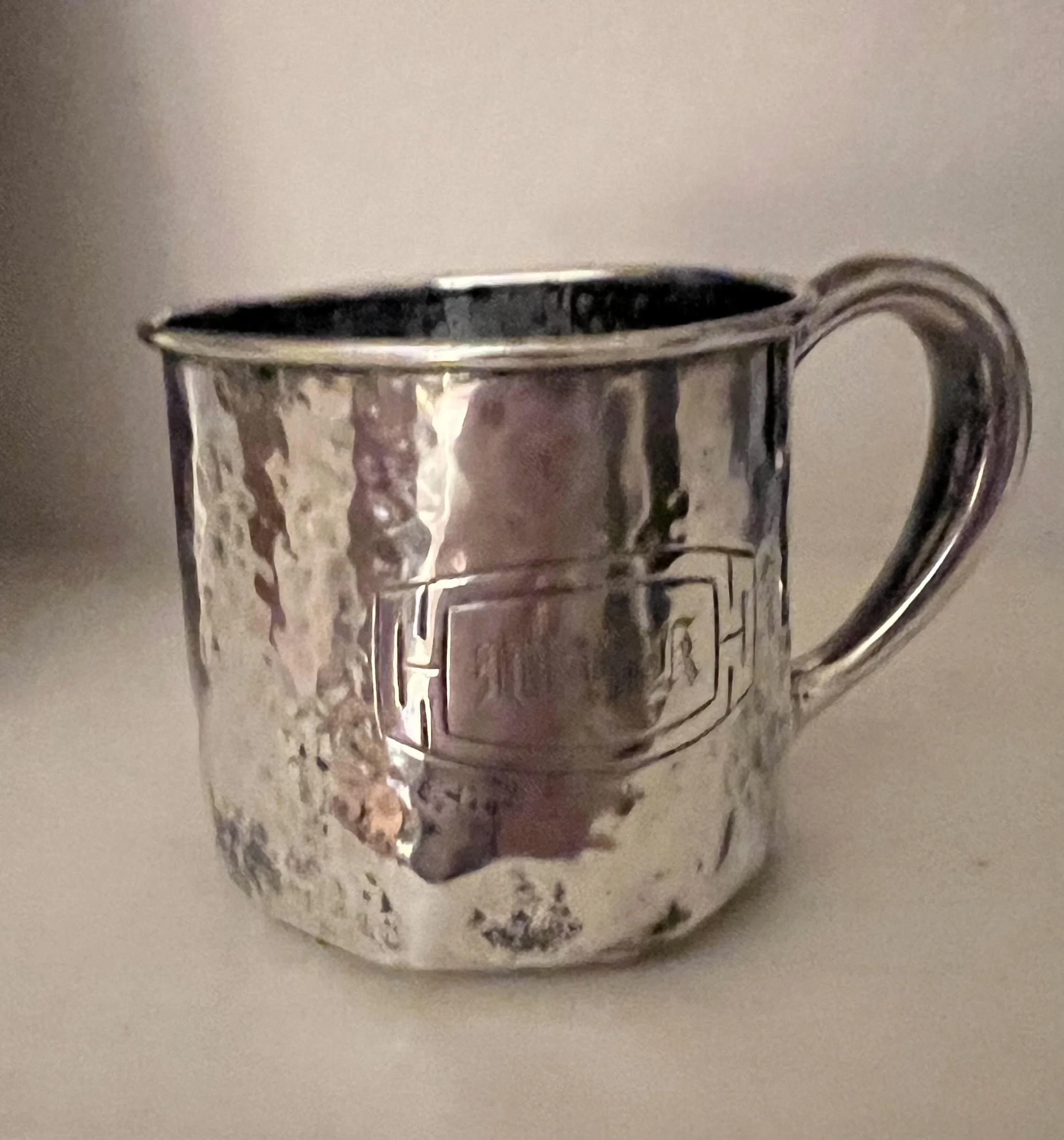
Many years later, after my mother died, when I was already a grandmother, my father gave me a box filled with items my mother had saved from her mother’s apartment. There were pictures; a couple of wristwatches belonging to my grandfather, who died before I was born and for whom I’m named; and a small silver cup. My father told me it was a baby cup that my great-grandfather had made for my mother when she was born. It’s engraved with her initials, W.H.K. I brought the cup home, polished it, and put it on a shelf.
Several years later, after my father had also passed away, I became interested in tracing my family’s genealogy. I sent away for a copy of my great-grandfather’s death certificate and learned that he was buried in a cemetery in Staten Island. (My husband and I later spent the better part of a morning hacking through vines and bushes to uncover the gravestone.) The death certificate also listed the “Cause of Death” as “Death by asphyxiating gas.” That was interesting, I thought. I called my mother’s 80-year-old cousin Patsy, the only family member remaining from that generation. “Oh, that makes sense,” she said. “My grandmother told me he stuck his head in the oven.”
“What else do you know about him?” I asked her.
“Oh, not much,” she answered. “He died in 1910, before I was born, and since my grandparents had been divorced, my grandmother didn’t really talk about him.”
But wait, I thought—how had I not realized earlier that the silver cup origin story didn’t make sense? My mother also wasn’t born yet when he died—so how could he have engraved it with her initials? Or even known that he would have a grandchild? My mother was named for him, and they have the same initials, so perhaps he made the cup for himself. But why would he have made himself not cufflinks, nor a watchband, nor even a silver box for storing his cigarettes or pipe tobacco—but instead, a tiny silver baby cup?
I’ll never be able to solve this mystery. But I am documenting for my own children everything I do know about their ancestors (including their parents): compiling birth, marriage, and death certificates; labeling pictures; making lists of who’s buried in which cemeteries. They’re not particularly interested now—they’re busy raising their own kids, and probably feel, as young people do, that there will be plenty of time for that later. But it’s satisfying to me to know that a few decades from now, if they do become curious, they won’t have the same regret I have: why didn’t I ask more questions?