Evelyn Shapiro
In the 1950s, many people who fought racism and classism in the U.S. endured endless waves of government-funded harassment. After years of being targeted by the FBI, getting blacklisted, and ordered before the House Unamerican Acts Committee, my grandparents, my mom, and my uncle had collected both proud and painful memories.
Because most of my career has been spent advocating for workers’ rights, many of my Zeide’s labor union and civil rights possessions were generously passed on to me— IWW (Wobblie) song books and steward guides, old labor contracts, awards for fighting McCarthyism.
When my Nana pressed me about what I wanted to inherit, however, I always replied simply, “The nudes.”
Nana (Esther) had posed nude for an artist in the late 1940’s. These framed black and white photographs hung boldly throughout their home; in the cheekily decorated hot pink guest bathroom, in the simple hall bath, in their bedroom. Nana’s audacious embrace of her sexuality in such a socially conservative time fueled my admiration for her chutzpah and courage.
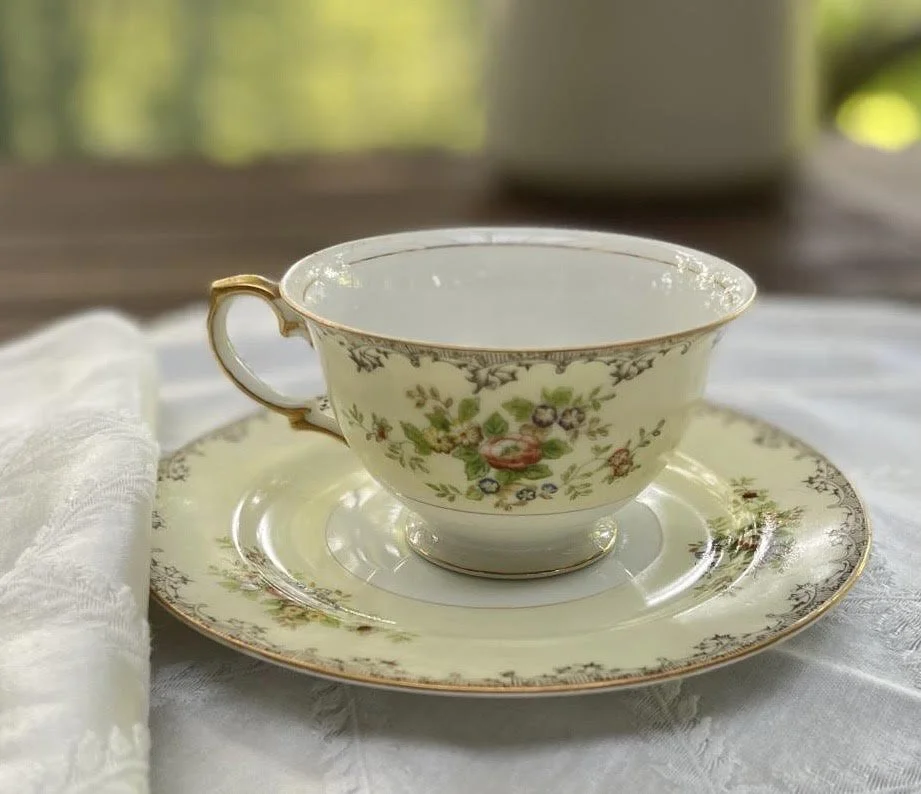
Nana had promised me the nudes, but also said, that as her only granddaughter, I should receive her ornate yellow Japanese Meito wedding china. I didn’t feel much sentiment for the dishes at first. I hadn’t spent time playing with them on the floor like the Russian nesting dolls, or the heavy flat bottomed stacking cones that were always available to us grandkids. But since Nana wanted me to have them, I began to grow fond of the dishes and imagined using them in my adult home—maybe for Passover dinners or tea parties with my kiddo.
Alas, when Nana died at age 96, my mother was navigating many details and overlooked the promised china. The pristine set went to an estate sale and landed in the hands of someone disconnected from that promise.
I initially mourned this oversight. It didn’t feel fair that Nana’s intended heirloom was passed on to a stranger. I soon decided to pivot and began to feel hopefully certain that someone who needed dishes got a nice set at a good price and got to experience a little bit of luxury while they dined.
This loss made me reflect: many people don’t have family heirlooms—some fled war-torn homelands, some were too poor to pass things down (making the concept of heirlooms a fantasy, or rich people stuff), and others lost everything to fire or flood.
I wondered: Can story and essence live where we assign it, even if it didn’t physically originate in that item? Do we abandon access to heirlooms if they are lost or do we have a chance to re-instill their spirit elsewhere?
A few years after Nana died, my mom found a remaining platter from Nana’s china and gave it to me. To honor Nana’s wish, I set out to find a similar set. I knew I wouldn’t find the exact one, but that serving dish faithfully guided my search.
After months of searching, I found a similar Meito set and picked it up from someone’s nearby storage. I decided to adopt it as the wedding china Nana had meant for me.
Maybe stuff is just stuff until we decide it has meaning.